Software revolution on wheels
The automotive industry finds itself in a process of fundamental change: departing from rigid mechanical systems toward digital, connected platforms. Software assumes a key role in the wake of this paradigm shift. Functions that used to be achieved mechanically are now controlled by software – from powertrain control to safety functions to personalization of the driver’s experience.
The global market shows how fundamental this change is: For software-defined vehicles (SDVs), it grows by more than 25 percent every year, according to Future Markets Insights, but software alone doesn’t move any vehicle. It unfolds its effects only by interacting with mechanical systems, electronics, and energy efficiency. That’s exactly where Schaeffler comes into play: with a systematic approach that fuses software-defined architectures, electric powertrains, smart chassis solutions, and highly integrated modules.
At CES 2026, Schaeffler is showcasing how software, vehicle dynamics, and efficiency combine to create a new vehicle logic. From central control architectures to steer-by-wire solutions to magnet-free sensors, compact power electronics, and smart battery systems, it’s clear that mobility of the future isn’t the product of individual innovations but of the precise interaction of many components.
What is a software-defined vehicle?
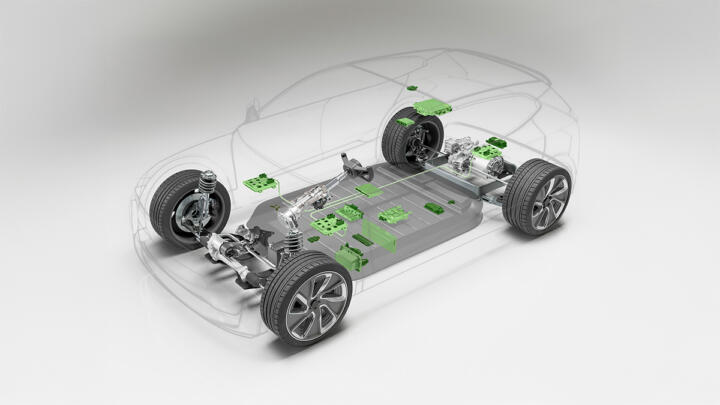
A software-defined vehicle (SDV) is a vehicle whose functions are primarily determined by software – not by permanently installed hardware.
Typical characteristics
- Central computers instead of many individual electronic control units (ECUs)
- Vehicle software configurable via cloud in a flexible, modular, and customer-specific manner
- Separation of hardware and software
- Continuous further development across the lifecycle
Why that’s important
Vehicle manufacturers can keep their models updated longer, retrofit them with functions, and develop new business models.
“Due to the combination of our extended software functions with integrated motion, energy, and control systems, we reduce the complexity of vehicle architectures and enable real-time control.”
Jeff Hemphill, CTO Schaeffler Americas
System solutions instead of single parts: Schaeffler’s new role
Hardware drives – software decides
Previously
- Functions were firmly tied to components
- Modifications required new hardware
- Innovations came with model cycles
Currently
- Software controls vehicle functions
- Updates are made over the air
- Vehicles keep evolving over the years
Consequence
Automobiles turn into platforms – comparable to smartphones on wheels.
When vehicles become more digital their architectures must think digitally too. Instead of dozens of small ECUs there are central modules that provide flexible functions and can be continuously developed further – like in the case of smartphones.
Schaeffler has fundamentally changed in recent years: from a classic component supplier to a systems and solutions provider. A milestone achievement was the integration of Vitesco Technologies whose software and electronics expertise has clearly extended Schaeffler’s capabilities in electrification and control technologies.
What Schaeffler showcases at CES
Electrification and e-axles
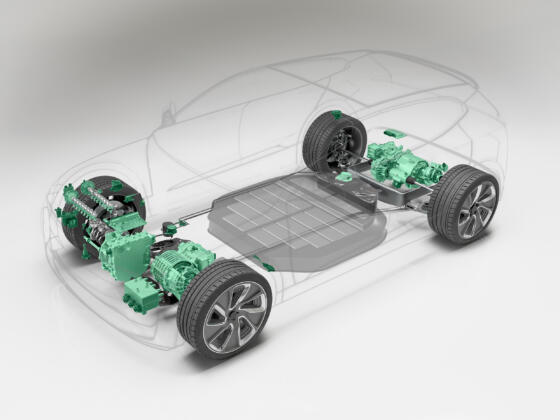
The electrification of the powertrain continues to be a key topic of the automotive industry: At CES 2026, Schaeffler is showcasing modular e-axle drives like the EMR4 combining the motor, power electronics, and transmission in a compact system. The modular architecture enables flexible integration into various vehicle platforms – from sub-compacts to SUVs.
Technically, that means:
- Compact designs for high power density
- Modular configurations depending on the use case
- Variants without rare earths to reduce resource dependencies
- Integrated thermal management modules for efficient temperature handling
These properties are decisive for the competitiveness of electric vehicles – they determine costs, efficiency, and integration depth.
Software and control architectures
Software-defined vehicles need a digital nervous system: an E/E architecture that intelligently combines sensors, actuators, ECUs, and functions. For this purpose, Schaeffler develops master control units (MCUs) and zone control units (ZCUs) that perform powerful control functions in the vehicle’s onboard system.
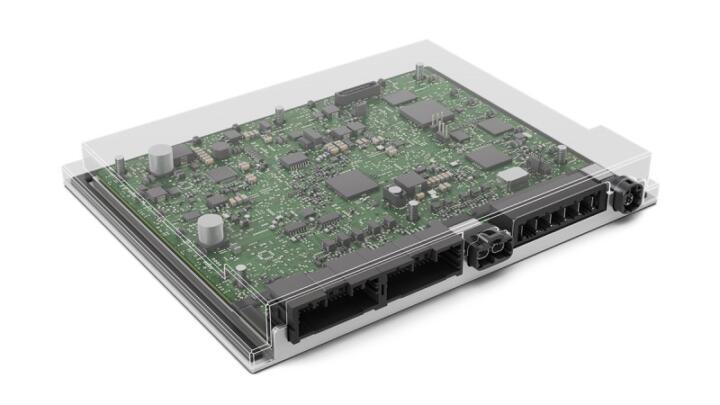
What does that mean? Let’s imagine a car as a mini data center on wheels:
• Sensors gather data (e.g., speed, wheel position, energy flow)
• Controllers process the data in real time
• Software functions respond accordingly (e.g., power steering, energy management, driving mode adjustment)
This results in a system that not only drives but actively controls the vehicle’s condition and responds to new requirements – via updates, new functions, or extended services.
Steer-by-wire: When software defines steering feel
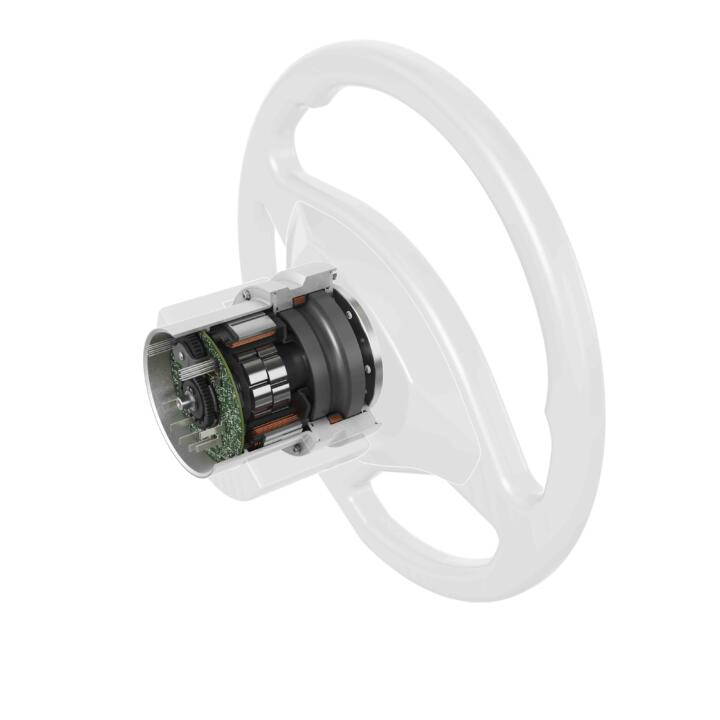
The increasing electrification of the chassis paves the way for another key technology of the software-defined vehicle: steer-by-wire. The mechanical connection between the steering wheel and the wheels is eliminated, control commands are electronically transmitted, and processed by software.
For this purpose, Schaeffler combines hand wheel actuators with force-feedback systems that generate a natural, adaptable steering feel – regardless of whether the vehicle is being moved in manual or automated mode. That enables not only new driving modes but also new interior concepts, for instance by means of a retractable steering wheel. In that way, steer-by-wire becomes a connecting link between the chassis, software, and automated driving.
Vehicle dynamics reimagined: When efficiency is created in the chassis
Electrical range is often reduced to battery capacities or charging performance but a considerable portion of the efficiency of modern vehicles is created in a different place: in the chassis. Any amount of friction saved, any kilogram less, and any motion that’s more precisely controlled has a direct effect on energy consumption, stability, and costs.
Schaeffler addresses exactly these levers with a range of chassis and vehicle dynamics technologies with a common denominator: they combine sensors, actuators, and software into integrated systems that improve efficiency not in isolation but holistically.
A key example is the magnet-free inductive sensor for the rear-wheel steering system (iRWS). It measures the angle and position of the rear wheels in a contactless process via electromagnetic fields – precisely, robustly, and without the use of rare earths. The data are fed into the steering system in real time and enable situation-dependent control of the rear axle. That results in more agility at low speeds, greater stability at high speeds, and additional safety in critical driving situations.
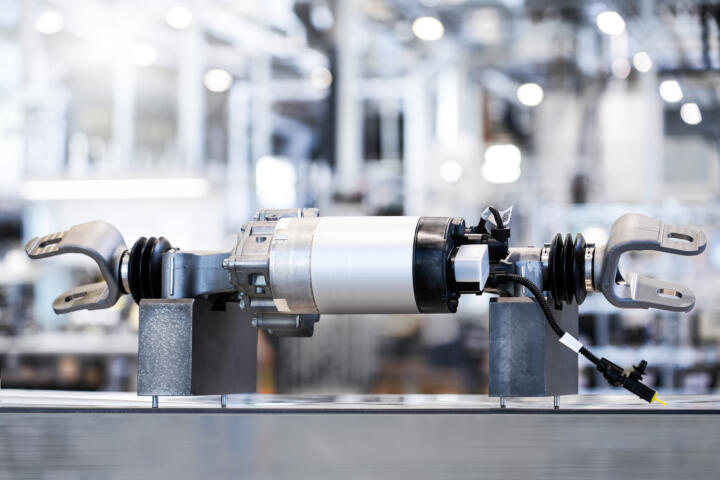
Its benefits are particularly obvious on battery-electric vehicles. Long wheelbases, which are necessary due to battery packs installed under the floor, make agility and maneuverability more difficult. Rear-wheel steering systematically counteracts this design-related disadvantage – not as a comfort function but as a functional contribution to efficiency and drivability. At the same time, vehicles with other types of powertrains benefit from enhanced tracking and more stable handling as well.
In addition, rear-wheel steering improves not only maneuverability in urban traffic and facilitates parking but also enhances stability during lane changes and at higher speeds. As a result, rear-wheel steering becomes an active safety and comfort factor. These effects are of benefit not only to battery-electric vehicles but to vehicles with any type of powertrain – due to greater agility, more precise handling, and a generally more harmonious driving experience.
Invisible key technologies: Actuators, transmissions, and bearings
Besides sensors and software, actuators and mechanical core components make the main difference. Schaeffler is showcasing brushless direct current motors (BLDCs) that have been developed specifically for steering and chassis applications. They combine high power density, low inertia, and functional safety in a compact design space. Thanks to their scalability they can be used not only for steering systems but also for other functions close to the chassis.
These solutions are complemented by planetary roller gears – compact electromechanical actuators that can replace hydraulic systems. They transfer high forces in a very small space, can be precisely controlled, and reduce system complexity and maintenance requirements. That makes them perfect examples of the transition from hydraulic to electrified, software-capable integrated systems.
Schaeffler puts new emphasis also on established components. Optimized wheel bearings and third-generation TriFinity™ bearings increase stiffness, reduce friction, and enable more precise wheel guidance – without additional design space. For electric powertrains, that means lower losses, longer service life, and a direct, albeit invisible contribution to everyday energy efficiency.
Integrated modules for electric and hybrid platforms
Growing along with the electrification of modern vehicle architectures is the challenge to achieve increasingly larger scopes of functions in the face of smaller design space and lower weight. Schaeffler counters that complexity with highly integrated system solutions.
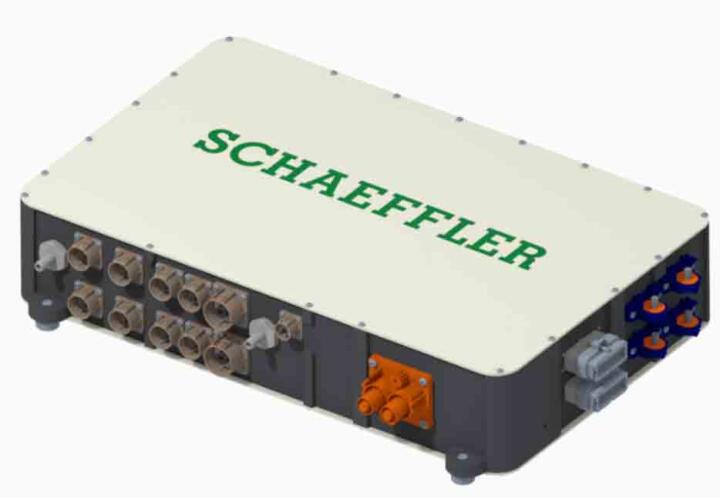
The SuperBox 4-in-1, a compact 800-volt power electronics unit combining an inverter, on-board charger, high-voltage DC boost, and additional modules for 12- and 48-volt systems, is a case in point. Due to this integration, weight, costs, and system complexity can be reduced while new functions such as V2X and smart grid applications are supported simultaneously.
Schaeffler does not regard battery packs as isolated energy storage devices either but as complex systems. Lightweight housings, advanced thermal management concepts, and condition monitoring sensors ensure that batteries operate efficiently and safely in the optimal temperature window. This is complemented by software-based algorithms for state of charge (SoC) and state of health (SoH) monitoring that dynamically adjust the charging and discharging flow and thus increase service life and reliability.
Software eco-systems and services: New ways to create value
A frequently underrated aspect of SDV transformation is the software eco-system itself: Functions are provided not only in the vehicle but continuously developed further – via over-the-air updates, new apps, personalized profiles, or safety/security and convenience services.
Schaeffler has recognized this trend: Its proprietary E/E platform is not only hardware but a software framework that’s scalable and extensible. New business models can be created in that way – from retrofittable functions to data-based services across the entire vehicle lifecycle.
Why that’s relevant – for automakers, industry, and all of us
The mobility layer of the future is going to be determined by electric, connected, and software-controlled systems. For vehicle manufacturers, that means:
- Faster development cycles
- Constant expansion of functions
- New sources of income due to services
For industry in general, that means: Software is going to become a strategic differentiator. Not just the mechanical components will define a product – but so will its digital intelligence.
For us as users, that means: Vehicles that gradually become smarter. Updates that provide new functions. Systems that can be personalized, plus mobility that’s continuously being improved – without visiting a garage.
Looking forward
The technologies that Schaeffler is showcasing at CES 2026 are no isolated or stand-alone innovations. They stand for a systemic approach that imagines the chassis, powertrain, electronics, and software as a whole – as an integrated platform for mobility of tomorrow.
Those who understand how software and hardware interact have a clear idea of how fast progress is created, and Schaeffler explores exactly that frontier of what’s possible – with solutions that define not only technology but experiences.
Because mobility changes step by step – becoming more silent, more digital, and more software-driven.
Besides performance and function, sustainability and resource efficiency play a key role too – for instance, due to durable components, integrated systems, and systematic elimination of the need for critical materials.


