Humanoids: The future begins now
Following the steam engine, automobile, computer, smartphone, and AI, the next disruptive technology is at the ready: humanoid robots. We might soon be living in a world in which humanoid robots are at work around the globe – in factories, warehouses, doctor’s offices, and in our own four walls. Schaeffler, alone, is planning to integrate a medium four-digit number of humanoids in its production network within the next ten years.
The motion technology company is far from being alone in pursuing such plans. Analysts at financial services provider Morgan Stanley predict that the market for humanoid systems might grow up to five trillion U.S. dollars by 2050 and that by then around one trillion humanoid units will have been deployed – around 90 percent of them in industrial and commercial settings. That would mean one in ten people would enjoy the support of a humanoid.
Time will tell whether it’s really going to be that many but almost all experts agree that humanoid robots have massive market potential. Schaeffler has identified that business segment as a high-potential growth market as well and positioned itself with corresponding breadth. With its pioneering DNA and global manufacturing excellence, the company is pursuing a clear mission: to become one of the leading technology partners in the growing humanoids market. Andreas Schick, Chief Operating Officer of Schaeffler AG and responsible on the executive board for humanoid activities, says, “Schaeffler aims to secure a key position in the rapidly growing humanoid robotics market.” Due to its decades-long manufacturing expertise, the company can deliver individual components and systems at the highest levels of quality in large numbers within the shortest production times.
These are the four areas of humanoid robotics in which Schaeffler is active:
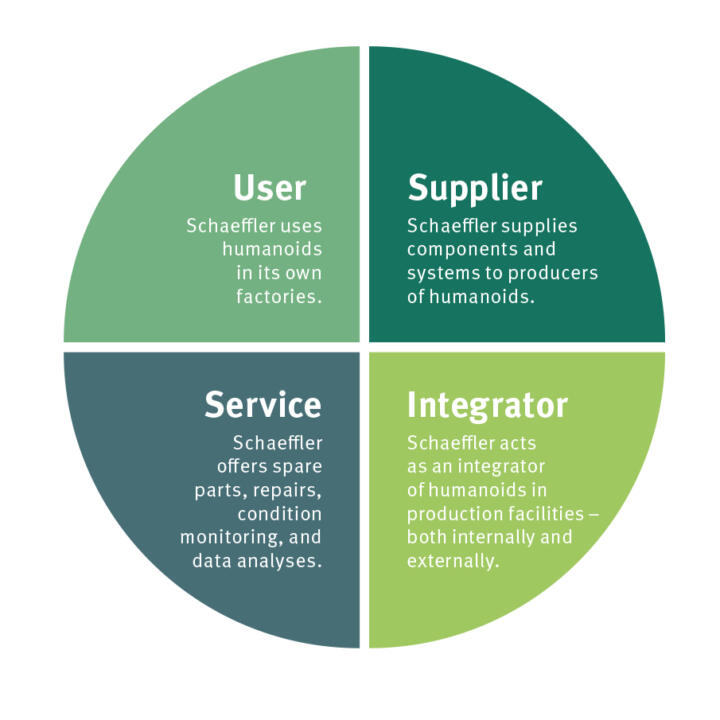
Schaeffler deploys humanoid robots along the entire value chain and therefore has first-hand knowledge of the needs and demands of the market. Consequently, Schaeffler manages to successfully transfer scalable solutions from the automotive and industrial business into humanoid robotics and to develop tailored products addressing the challenges of the future. With an extensive portfolio from eight product families, the company covers the gamut of demands made on humanoid robots. Integrated linear and rotary actuators – one of Schaeffler’s key competencies – account for about half of the components of a humanoid. That highlights the strong vertical integration and concentrated expertise of the motion technology company.
Sebastian Jonas, who in his role as Head of Advanced Production Technology at Schaeffler is dedicated to deploying the use of humanoids at Schaeffler’s plants, is thrilled by the versatility of the human-machine devices, saying that “humanoid robots see, understand, and decide in real time and can be seamlessly integrated into the entire value chain from logistics to the factory floor, but economy is going to be the decisive factor for achieving their breakthrough: humanoid systems are going to make it into industry across the board only if they’re cost-efficient, easy to integrate, and highly available.”
Humanoids – the all-rounders
“I believe in peaceful robotics that helps and supports people. Looking at the global development – with its increasingly aging population – we’re going to be short of 100 million workers in the next five years in China, Japan, and Europe alone. The robotics market is going to be the largest market in the world,” says David Reger, CEO and founder of Neura Robotics, in an interview with The Pioneer.
Humanoid robots are on the verge of stepping in wherever there’s a shortage of humans or the burdens on them need to be eased. Here are some examples:
Humanoids@manufacturing
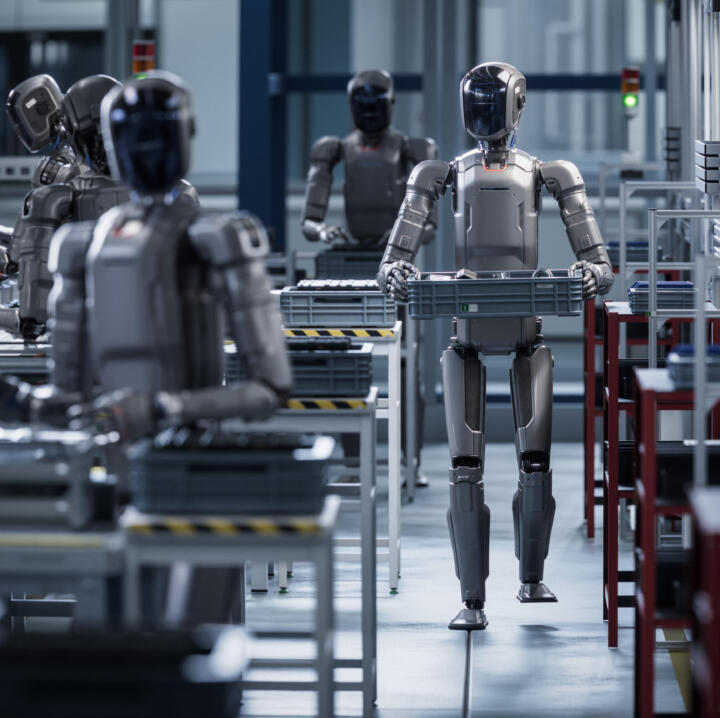
Humanoids in industrial settings can seamlessly integrate themselves in existing work environments, ease the burden on people in repetitive and ergonomically challenging jobs, and thus clearly increase productivity. Due to their human-like mobility, they can be included in existing manufacturing cells, where they can reliably perform tasks like material supply or bolting jobs, for example.
Humanoids@logistics
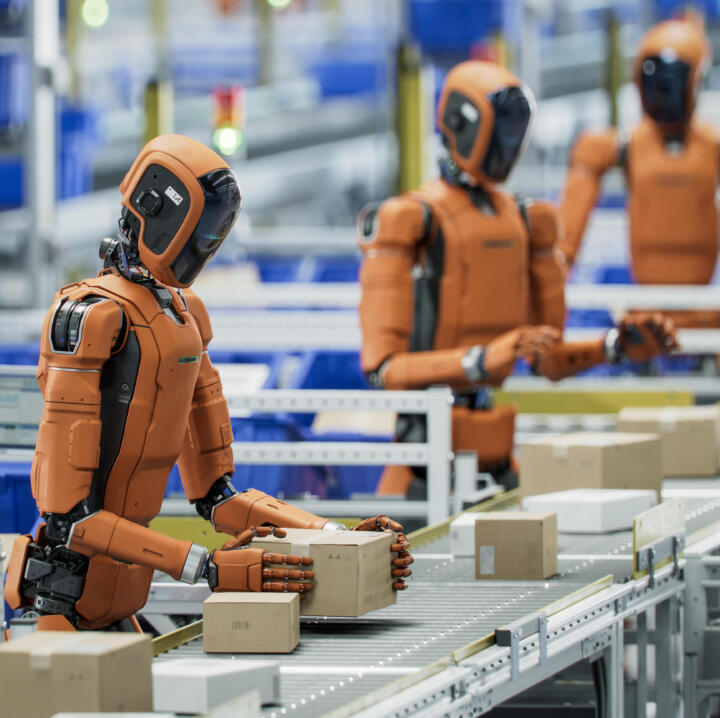
Humanoids could be revolutionizing logistics: They lift, haul, and sort goods, handle inventory checks, and picking jobs – around the clock. Their human-like agility enables flexible activities in narrow warehouse aisles or on uneven floors where classic robots reach their limits. As a result, they enhance efficiency, reduce errors, and noticeably ease the burden on employees.
Humanoids@doctor, hotel, home
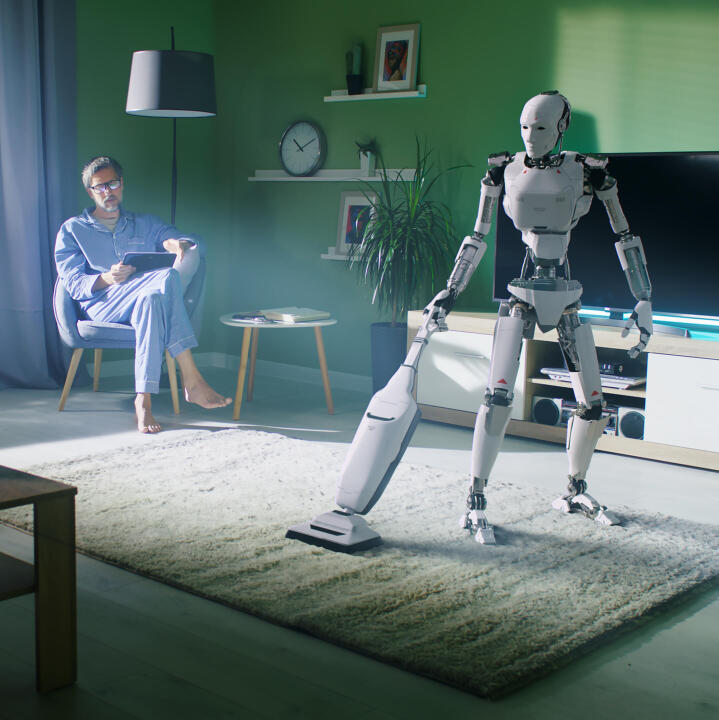
“The field of robotics is going to be clearly larger than the market of smartphones, automotive, and all that combined. There will be robots in the private sphere, in every household as well as in every industry, in every restaurant, in every hotel, or at the doctor’s office,” says David Reger, CEO and founder of Neura Robotics, Technology partner of Schaeffler.
Schaeffler provides power and mobility
25 to 30 actuators in joints like shoulders, hips, or knees – Schaeffler’s actuators deliver maximum precision for them.
Around 50 % of all the components of a humanoid belong to the areas of linear and rotatory drives.
The most recent product highlight from Schaeffler in the field of robotics is a planetary gear actuator specifically developed for humanoids that Schaeffler is showcasing at a globally leading trade show for the first time.
Capabilities of the tailored drive solution
- Compact design: The system combines a two-stage planetary gearbox, an electric motor, an encoder, and a controller in a space-optimized unit.
- Powerful performance: The integrated actuator covers a torque range from 60 to 250 Nm, remains thermally stable, and delivers high torque transparency for dynamic and precise motion.
- Back-drive ability: While many conventional actuators hardly have any back-drive ability the innovative Schaeffler planetary gear actuator has controlled reverse motion – a key advantage for sensitive, reliable, and energy-efficient robotics.
- Made completely in-house: All components – from the two-stage planetary gearbox to the motor, encoder, and controller – stem from in-house development and production, which guarantees quality, reliability, and perfect system coordination.

“The innovative planetary gear actuator is a production-ready key product from our product portfolio and is going to make humanoids even better and more capable.”
Partner of science
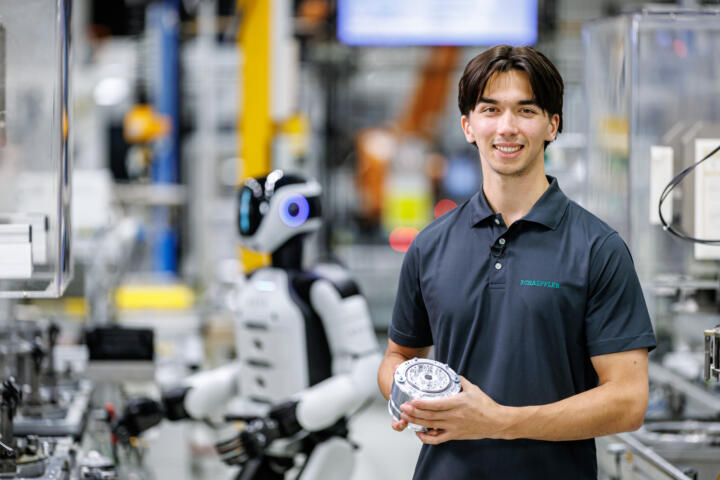
In a new large laboratory at Nanyang Technological University (NTU) in Singapore technologies for robotics and artificial intelligence are being developed, enabling Schaeffler to raise its long-standing partnership with NTU to a new level. The collaboration with globally leading research institutions supports the motion technology company in becoming a preferred technology partner for humanoid robotics. Schaeffer has numerous partnerships with key global humanoids manufacturers that encompass delivery agreements for components. Read more here.