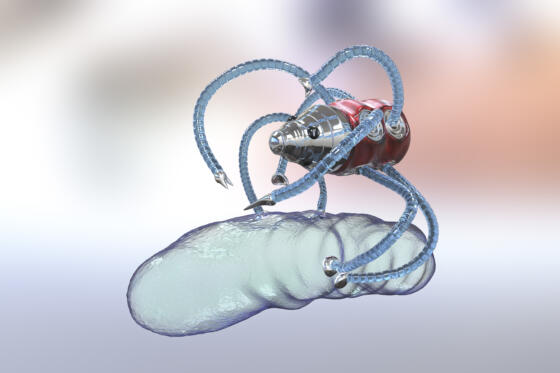
The future of efficient space travel?
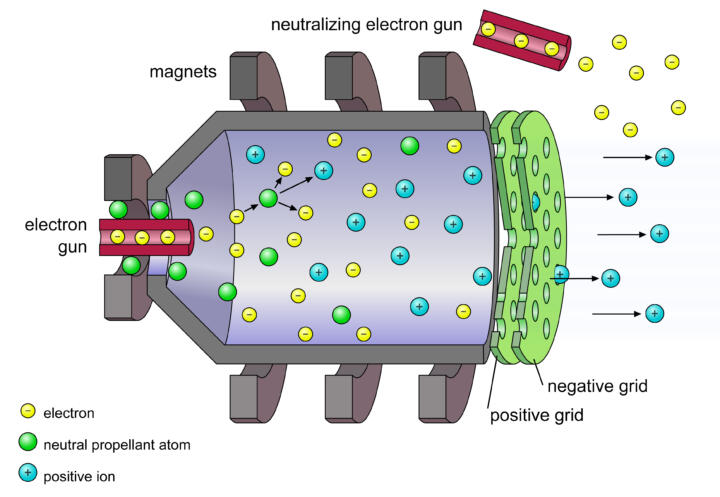
Before we lift off, let’s look at some basics in fast forward mode. Collectively, the term ion thruster encompasses a whole family of related propulsion technologies. Their technical implementation may vary according to their purpose, just like there are differences with internal combustion engines between diesel engines and gasoline units and between naturally aspirated and turbocharged powerplants. Regardless of whether the emphasis is on maximum efficiency or higher thrust performance, all ion thrusters are based on the same functional principle. Firing against a service medium (currently a gas such as xenon in most cases) with free electrons extracts the medium’s own electrons from it. The atoms that are now ionized form a positively charged plasma that’s being massively accelerated by the flow of electrostatic or electromagnetic fields (plasma thrusters) through it. This kinetic energy is converted into thrust. After exiting the engine, electrons are again added to the plasma in a neutralizer to prevent charging of the spacecraft.
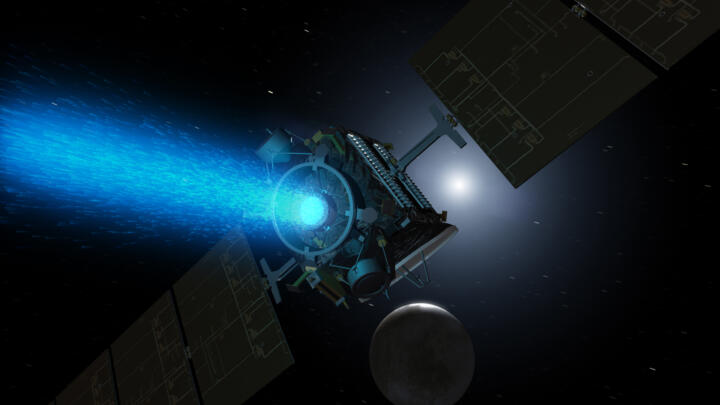
Ion thrusters are regarded as fuel-saving units among space thrusters and are particularly well-suited for long-term missions or compact and light-weight spacecraft. The more powerful plasma engines are the workhorses among ion thrusters. Within the family of plasma engines, the Hall effect variants are especially powerful and robust, as a result of which they’re in widespread use. The effect named after its discoverer Edwin Hall means that a (typically electrically generated) magnetic field forces electrons onto circular paths while the medium’s heavier ions are hardly affected. That creates an electric field transversely to the flow direction (the Hall effect) that accelerates the positively charged ions with particular emphasis toward exiting.
Minimal thrust, massive endurance
When ion thrusters are described as “powerful” that must be understood in very relative terms from an earthly point of view. Although the ion beam can reach exhaust velocities of 200,000 km/h (125,000 mph) (ten times faster than in the case of conventional chemical rockets) the resulting achievable thrust of 0.01 to 0.1 Newtons remains negligible. For comparison: Each of the two launch vehicles of a Space Shuttle mission pushes toward the sky with 14.5 million Newtons. With the Millinewtons of an ion thruster no more than a sheet of paper could be lifted on Earth. However, in the vacuum of outer space, these mini forces when acting over a longer period of time are sufficient to move satellites, probes, and other spacecraft for orbital corrections, for example. At a ground test run by NASA, an ion thruster provided continuous thrust for 5.5 years.
While behemoths such as shuttle rockets burn 500,000 kilos (1,100,00 lbs.) of fuel within a few seconds, ion and plasma thrusters make do with between 10 and 150 kilos (22 and 330 lbs.) of heavily compressed inert gas as fuel for flying through space on missions that may last for years – and of course electrical energy to ionize and accelerate the gases.
Solar or nuclear power?
The electric power requirement of the ion thrusters is covered by solar wings or mini reactors. Giuseppe Racca, the project leader at the European Space Agency (ESA) emphasizes that solar-electric drive technology paves the way for exploring the inner areas of our solar system because that’s where the inexhaustible energies of the Sun can be tapped. By contrast, in the outer regions of our system far away from the Sun, other electric power sources must be used such as on-board nuclear reactors.
Around the world, evolutions of electrostatic drives aim to significantly increase thrust to develop further uses in space. More thrust boosts electric output – and in turn the internationalization and commercialization of space boosts development. Whether in Germany, Austria, France, India, Japan, or the United States, whether at universities, startups, or established companies – around the globe, ion thrusters of various designs are in development or are already running on test benches. Aside from thrust improvements, efficiency enhancements as well as design space and weight savings are the focus.
Obviously, NASA is involved as a big player. The U.S. Space Agency, for instance, has now successfully tested the prototype of a magneto plasma dynamic (MPD) thruster that instead of using gases such as xenon, crypton, or argon operates with ionized lithium. According to reports, the prototype is about 25 times more powerful than the propulsion system of the “Psyche” space probe that with four engines each having 0.24 Newtons of thrust has so far been regarded as the NASA reference in the area of electric propulsion systems.
To ionize and accelerate the plasma, the MPD prototype needs 120 kW of power output. The next output leaps are already being planned: 500 kW and 1 MW with corresponding thrust increases are supposed to be achieved in the next few years. As a mid-term goal, NASA states 4 megawatts. Such levels can hardly be managed with solar power which is why this technology is planned to be combined with a nuclear fusion reactor as the power source. Instead of small satellites and probes, such powerful electrostatic propulsion systems can also be used to move larger spacecraft at higher speeds through the vacuum in space, such as for crewed Mars missions, as cargo transporters toward the Moon, for active removal of space debris, or for long-term missions to outer planets.
British startup Pulsar Fusion is planning to test an ion thruster with a fusion reactor in orbit in 2027. With 2 MW of power output, a plasma exhaust velocity of 360,000 km/h (224,000 mph) and thrust between 10 and 100 Newtons are supposed to be achieved. According to the company, an acceleration phase of just a few hours is supposed to produce enough propulsion for interplanetary missions to Mars.
Despite all gains being pursued, it’s clear that the thrust of electrostatic drives will by far be inadequate to overcome the force of gravity using spacecraft within the foreseeable future. For traveling into space, conventional rockets will continue to be needed. Up with oomph and then efficiently gliding to the vehicle’s destination in space with ion thrusters.
And what does the situation look like down on Earth?
Physically, a direct use of classic ion drives in Earth’s atmosphere is regarded as being hardly practical due to their low thrust. Even so, in November 2018, a research team at MIT made headlines with a mini aircraft (5-meter / 16-feet wingspan, 2.5 kilo / 5.5-lb weight) propelled by “ionic wind.” “tomorrow” reported about the project as well. Unlike the ionic thrusters used in space, in which the accelerated particles are shot out radially, ionic wind uses a planar concept. On the aircraft, the particles are accelerated underneath the wing in multiple layers between several pairs of electrodes with a voltage difference of 40,000 volts.
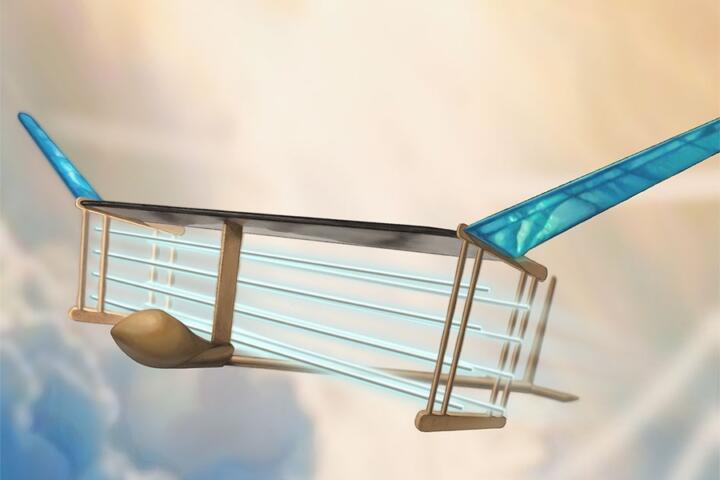
In that way, 500 watts of electric power output generate thrust of 3 Newtons. Enough to fly over a distance of 60 meters (200 feet) in a windless hall. “This was the simplest possible plane we could design that could prove the concept that an ion plane could fly,” said Aeronautics Professor Steven Barrett, a member of the project team, adding that “It’s still some way away from an aircraft that could perform a useful mission.” How far away is followed by a question mark.
Drones flying with ionic winds could at least mark another intermediate step on the development path. In 2025, researchers at the Chinese universities of Nanjing and Zhejiang presented an ionic wind thruster for flying microrobots (additional info). The results underline the potential of multi-engine ion wind systems for the further development of the flight dynamics of micro-robots with significant effects on the design of next-generation micro-scale aircraft, according to a supporting article.
Researchers in Australia took the ionic wind to water, using the water surface as a downstream electrode, thus eliminating the need for a second electrode. In the experiment a so-called iBoat with a payload of 120 grams (0.26 lbs.) was successfully propelled.
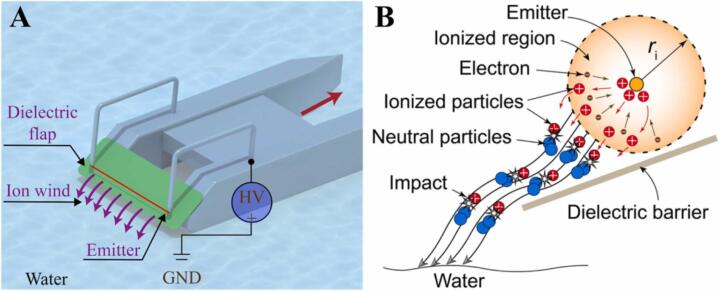
“This novel concept might pave the way for the future development of propeller-less boats with trivial noise development in practical use cases including military surveillance missions and in nature conservation,” according to the researchers.
Pushing future mass transit to the speed of sound
Can you go even bigger? Yes, much bigger, and therefore potentially more suitable for everyday use, at least if Naveen Chaudhary’s vision for the Ringway Transport System becomes a reality one day.
The engineer for rail and local transportation has designed a high-speed mass transit system powered by an atmospheric air-breathing ion drive. First patented in 2012, he has continued to develop and refine the concept ever since. Unlike the Hyperloop, which relies on a complex vacuum tube system, this concept operates in open air, moving almost frictionlessly through magnetic rings integrated into a series of elevated support structures based on a moving cantilever beam principle. This magnetic levitation concept provides the primary propulsion. A further propulsion system, known as a Magnetoplasmaionic (MPI) Drive, would then provide additional boost, potentially accelerating the vehicle to the speed of sound. To increase output and efficiency, Chaudhary intends to feed positively charged air to the MPI thruster that‘s being ionized by so-called “energy nails” and carbon threads on the supports. If adequately ionized air is not available xenon gas helps out.
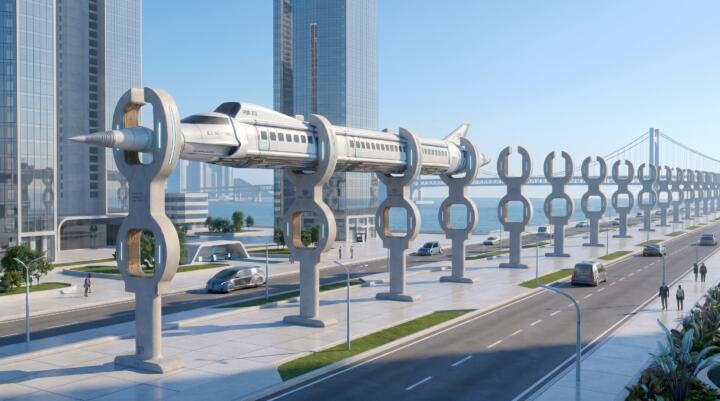
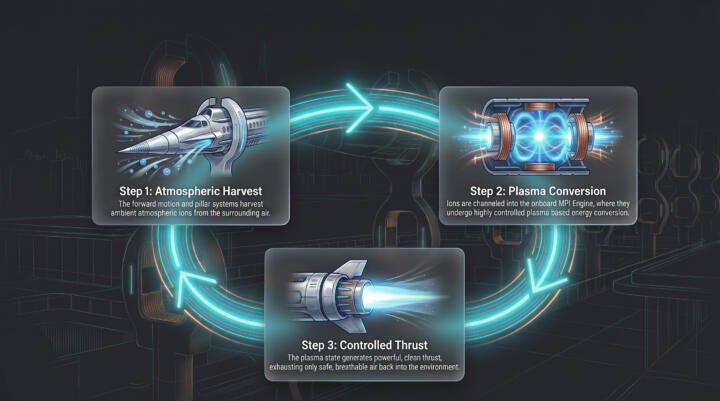
Like many researchers working on advanced transportation technologies, Naveen Chaudhary recognizes that enormous challenges must be overcome before the concept can become a reality. “It is a technologically very radical innovation,” he says and adds with a view to space: “However, I think the project is feasible, since we already have similar technologies at our disposal.”
According to Chaudhary, heat management is one of the particularly critical technical challenges: Like all ion drives, the MPI derivative must be operated within a highly limited space in extremely contrasting temperature ranges. “The plasma core generates extreme heat between 10,000 and 50,000 degrees Celsius. At the same time, the nearby superconducting magnetic coils must be kept at an icy minus 196.15 degrees with the help of liquid nitrogen,” says Naveen Chaudhary. “Coping with these immense temperature gradients and limiting the maximum thermal stresses to less than 50 percent of the material’s yield strength requires highly developed refractory materials and precise thermal design.”
In order to generate the thrust for supersonic speeds, the Magnetioplasmaionic (MPI) engine must convert power outputs in the multi-megawatt range without sacrificing efficiency or reliability. Chaudhary knows that “The provision and distribution of this power magnitude requires state-of-the-art superconducting energy transmission systems and massive energy storage solutions such as supercapacitors to absorb peak loads in operation.”
Naveen Chaudhary admits that the exploitation of the full potential of the Magnetioplasmaionic (MPI) engine depends to a large extent on future breakthroughs in materials science, in particular on the development of room-temperature superconductors: “The discovery of such materials would eliminate the need for a cryogenic infrastructure, drastically reduce costs, and significantly improve the overall performance of the engine.”
Next hurdle: According to Chaudhary, quantum computers are needed for the vehicle alignment in rings and control and monitoring of the complex system in the sub-millisecond range, which are also pie in the sky.
Whether for Mars spaceships, silent drones, or supersonic trains beyond today’s speed limits: Many concepts are still pie in the sky but any new development shows that ion and plasma thrusters are far from having fully exploited their potential.